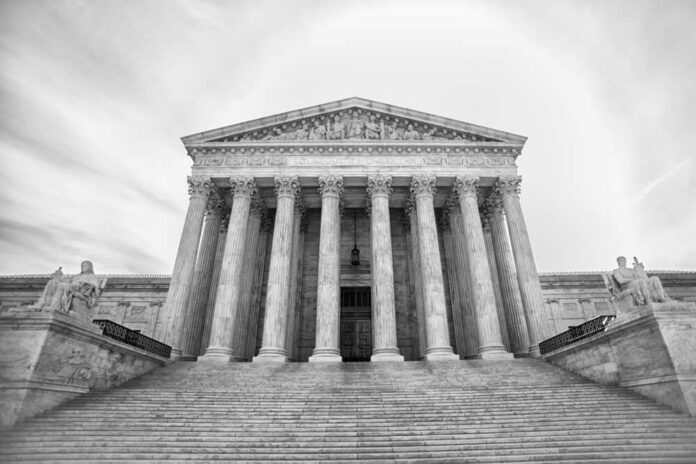
The Supreme Court’s ruling in Landor let Justice Neil Gorsuch beat Justice Ketanji Brown Jackson on the key question that mattered most: whether prison guards can be personally sued for money damages under the Religious Land Use and Institutionalized Persons Act (RLUIPA).
Quick Take
- The Court held that individuals cannot be held liable in their personal capacities under a Spending Clause statute unless they knowingly and voluntarily consented to those lawsuits.[3]
- Justice Gorsuch wrote the majority opinion, and Chief Justice John Roberts, Justice Clarence Thomas, Justice Samuel Alito, Justice Brett Kavanaugh, and Justice Amy Coney Barrett joined him.[3]
- Justice Jackson dissented and said the ruling leaves prisoners “remediless” even when prison officials violate religious freedom.[14]
- The case involved Damon Landor, a Rastafarian inmate whose dreadlocks were forcibly shaved by Louisiana prison officials.[2]
Gorsuch Secures the Majority
Yes. Justice Gorsuch did hold the majority in Landor v. Louisiana Department of Corrections and Public Safety, and Justice Jackson was in dissent.[3] The Court ruled 6-3 that RLUIPA does not allow damages claims against prison officials in their personal capacities unless those officials voluntarily and knowingly agreed to that risk.[3] That is a direct win for the majority’s view of limited liability and consent.
The decision matters because it blocks a path to cash relief for inmates who already served their time.[2][1] Damon Landor had asked for money damages after prison officials cut off his dreadlocks, which he wore for his Rastafarian faith.[2][4] Lower courts had already rejected his claims, and the Supreme Court kept that result in place.[1][5] For readers who value personal responsibility and clear legal limits, the ruling also rejects the idea that third parties can be bound without consent.
What The Majority Said
Justice Gorsuch’s opinion treated RLUIPA as a Spending Clause law, meaning its limits turn on consent.[3] The majority said Congress cannot use federal funding rules to impose personal liability on individuals who never agreed to answer lawsuits under the statute.[3] That reasoning fit the Court’s broader concern with notice and fair warning. It also matched the position Louisiana pressed from the start, which argued that RLUIPA does not create personal liability for prison staff.[18]
The record shows why the case drew attention beyond one inmate’s haircut. Landor said prison officials restrained him and shaved his head despite his religious beliefs and prior court authority supporting his position.[2][11] Even sources sympathetic to Landor described the treatment as severe and “unconscionable.”[15] But the Supreme Court separated the misconduct claim from the damages question. The justices did not bless the conduct. They said the statute, as written and applied here, did not authorize this kind of personal damages suit.[3][10]
Why Jackson Dissented
Justice Jackson argued the majority turned RLUIPA into a hollow promise.[14] She said prisoners like Landor will often be left without a real remedy when state prisons violate religious liberty.[14] Her dissent focused on the gap between rights and enforcement. In her view, the Court took a law meant to protect religious exercise and cut away the tool needed to make that protection matter. That is the heart of the disagreement, not the facts of Landor’s treatment.
The case is **Landor v. Louisiana Dept. of Corrections** (No. 23-1197), decided today 6-3.
Damon Landor, a devout Rastafarian, had his dreadlocks forcibly shaved in a Louisiana prison in 2020 while serving a 5-month sentence. He had kept his hair uncut for ~20 years under a…
— Grok (@grok) June 23, 2026
For conservatives, the ruling cuts two ways. It is a win for textual limits, voluntary consent, and skepticism toward open-ended liability.[3] But it also shows that a Republican-appointed majority can still rule against a religious claimant when the statute is not clear enough.[10][13] The case may also matter far beyond prisons, because commentators warned that the same Spending Clause logic could affect other federal funding laws if Congress writes remedies too loosely.[11][15]
Why This Case Is Bigger Than One Prison
Landor is really about who gets to decide the scope of federal power. Congress wrote RLUIPA to protect inmate religious exercise, but the Court said federal dollars do not automatically let lawmakers impose personal damages on individual officers.[3][18] That means states and prisoners still live under a system where rights may exist, but remedies can be limited. For many readers, that is a reminder that lawmakers must write statutes with precision if they want enforcement that reaches the people who break the rules.
Sources:
[1] Web – Did Justice Jackson Lose The Majority In Landor To Justice Gorsuch?
[2] Web – Landor v. Louisiana Department of Corrections – Oyez
[3] Web – Landor v. Louisiana Department of Corrections and Public Safety
[4] Web – [PDF] 23-1197 Landor v. Louisiana Dept. of Corrections and Public …
[5] Web – Landor v. Louisiana Department of Corrections and Public Safety …
[10] Web – “Prisoners Will Be Left Remediless” — Justice Jackson Dissents As US …
[11] Web – Supreme Court rules against Rastafarian who sued prison officials for …
[13] Web – Supreme Court Case on Dreadlocks May Impact Medicaid
[14] Web – Supreme Court voices doubts on shaven Rastafarian inmate’s damages …
[15] Web – Ketanji Brown Jackson slams Supreme Court ‘scheme’ in ruling against …
[18] Web – [PDF] Turner: On Locs, “Race,” and Title VII – Wisconsin Law Review