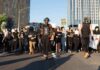
Iran’s Islamist rulers responded to a nationwide revolt the only way tyrannies know how—live fire, mass arrests, and an information blackout aimed at crushing the truth.
Story Snapshot
- Protests that began over inflation and food prices on Dec. 28, 2025, escalated into open calls to end the Islamic Republic.
- Reports compiled by international outlets and rights groups place the death toll in the tens of thousands, with estimates varying amid internet shutdowns.
- Demonstrations spread across all 31 provinces, drawing in merchants, students, minorities, and workers—an unusually broad coalition.
- Supreme Leader Ali Khamenei’s public order to put “rioters” in their place preceded harsher repression and fast-tracked prosecutions.
From Bread-and-Butter Anger to Regime-Change Chants
Iran’s latest uprising began on December 28, 2025, in Tehran’s Grand Bazaar, a historic nerve center of commerce and political pressure. Reporting summarized in the research indicates the first spark came from merchants angry over record inflation, soaring food prices, and a collapsing currency that hollowed out household budgets. Within days, the protests moved beyond economics as crowds in multiple cities chanted directly against Supreme Leader Ali Khamenei and the Islamic Republic itself.
Strikes and shop closures reportedly widened by December 30, with key commercial districts shutting down in Tehran and Isfahan. By early January, protests were no longer confined to major hubs; demonstrations were reported in smaller towns, and universities joined in. The research describes a rapid shift: by New Year’s Day 2026, analysts were calling the movement “unmistakably revolutionary,” with demands reaching as far as a referendum on Iran’s future system of government.
How the Regime Tried to Win: Bullets, Blackouts, and Courts
Iran’s government leaned on force and censorship as the crowds grew. The research indicates security forces escalated from crowd control into lethal measures, including reports of live ammunition being used as early as December 31 in multiple cities. On January 3, Khamenei publicly instructed that “rioters should be put in their place,” language that, in context, coincided with intensified crackdowns rather than de-escalation or reform.
Iran also targeted communication, relying on internet and telephone disruptions to prevent coordination and reduce the flow of evidence to the outside world. That kind of blackout does more than slow organizing; it makes casualty reporting harder to verify, which is why death toll estimates differ sharply across sources. The research further notes that Iran’s judiciary ordered fast-track handling of protest cases with “no leniency,” a sign the regime prioritized punishment and deterrence over due process.
The Scale Was the Story: A National Coalition Across Provinces
Analysts cited in the research describe this protest wave as different from earlier unrest because of geographic reach and the makeup of the crowds. Demonstrations reportedly touched all 31 provinces and more than 110 cities—an extraordinary scope in a police state. The coalition described includes merchants and shopkeepers, university students, teachers, artists, and ethnic minorities, including Kurdish and Baloch communities that have long faced heavy-handed security policies.
Peak protest activity was reported around January 8–9, with estimates in the research claiming massive turnout in Tehran and millions nationwide. Those figures are difficult to independently confirm under blackout conditions, but multiple sources converge on the same basic point: the regime treated those days as an existential threat and responded accordingly. By January 10, the research cites reporting that at least 2,000 people were killed in a 48-hour span, alongside widespread arrests.
Casualty Counts and the Limits of Verification Under Tyranny
The research cites competing casualty estimates, which is a warning sign about both the scale of violence and the difficulty of counting the dead. Human Rights Activists in Iran is cited as confirming at least 22,490 deaths by late January 2026, while other reporting cited in the research places the death toll during the peak days as high as 30,000–36,500. The gap reflects the reality of reporting from inside a closed regime, not a trivial discrepancy.
Even with uncertainty around exact totals, the consistent “tens of thousands” framing across referenced sources indicates mass bloodshed, not a limited riot response. The research also references eyewitness accounts of large numbers of bodies and ongoing repression. For Americans, the lesson is straightforward: when a government can cut communications, rush trials, and deploy lethal force on civilians at this scale, it’s a reminder why constitutional limits, free speech, and an armed citizenry remain foundational safeguards.
What to Watch Next: Mourning Dates, Nowruz, and Regional Ripples
The research points to upcoming flashpoints that could drive renewed unrest, including 40-day mourning periods for those killed and the Nowruz holiday on March 20. Iran’s leaders historically fear memorial cycles because grief can reassemble crowds even after crackdowns. The regime’s strategy—blame outsiders, tighten security, and limit information—may suppress protests temporarily, but it does not address the underlying triggers: economic failure, political repression, and public anger at unaccountable rule.
INCREDIBLE VIDEOS: PROTESTERS TAKE ON IRAN’S ISLAMIST REGIME https://t.co/W7Bf6TFggS
— Patriotic Night Owl (PNO) (@Patriot_Deanna) January 29, 2026
Internationally, the stakes extend beyond headlines. The research notes that Tehran has accused the U.S. and Israel of fueling the protests, a familiar tactic that can justify harsher internal violence and rally regime loyalists. Meanwhile, any major instability inside Iran can ripple across the Middle East, affecting energy markets, proxy conflicts, and security calculations for U.S. allies. For now, the most reliable conclusion from the compiled reporting is grim: a broad-based uprising met a regime willing to kill at scale to stay in power.
Sources:
2025–2026 Iranian protests
History of protests in Iran (timeline)
Iran Update, January 16, 2026
2026 Iranian Protests
Iran Update, January 8, 2026
Iran’s December 2025–January 2026 protest wave