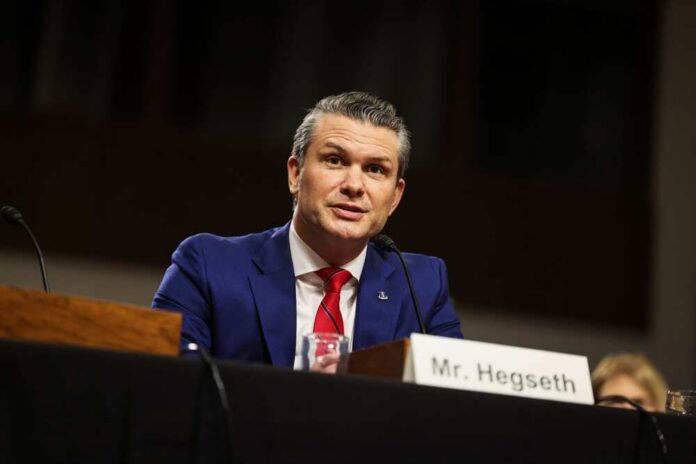
At the Normandy American Cemetery on the 82nd anniversary of D-Day, U.S. Defense Secretary Pete Hegseth stood among the graves of World War II heroes and delivered a message that had nothing to do with 1944 — and everything to do with 2026.
Quick Take
- Secretary of Defense Pete Hegseth used the D-Day commemoration at Normandy to warn that Europe faces a new kind of “invasion” — irregular migration carrying what he called “dangerous ideologies.”
- Hegseth named specific entry points — beaches in Spain, Italy, Greece, and Bulgaria — and challenged European capitals to take action against the flows.
- Critics argue the speech used a sacred military setting to advance domestic political messaging, while supporters say it was the most direct warning Europe has received from a senior American official in years.
- The full speech also included a call for allied recommitment, suggesting the migration remarks were part of a broader argument about Western resolve rather than a standalone attack on European policy.
What Hegseth Actually Said at Normandy
Speaking at the Normandy American Cemetery on June 6, 2026, Hegseth drew a direct line between the beaches stormed by Allied forces in 1944 and what he described as a present-day threat to European civilization. “Different European beaches are stormed by different dangerous ideologies,” he said, naming Spain, Italy, Greece, and Bulgaria as entry points where “boats and men arrive.” He then asked pointedly, “When will European capitals do something about that invasion?” [1]
The full speech, delivered during ceremonies marking the 82nd D-Day anniversary, was not exclusively focused on migration. Hegseth also honored the sacrifices of American and Allied soldiers and called for the transatlantic alliance to “remain ready, will rebuild, and will recommit.” That broader framing matters: the migration remarks were embedded in a larger argument about Western resolve and the durability of the alliance forged in World War II, not presented as a standalone policy indictment. [3]
The Controversy the Setting Created
Delivering migration criticism at Normandy guaranteed a polarized reaction. For supporters, the sacred setting amplified the urgency of the message — if the men buried there died to protect Western freedom, the argument goes, then threats to that freedom deserve to be named in that same space. For critics, using a solemn military commemoration to score political points on immigration policy was opportunistic at best and disrespectful at worst. Both reactions have flooded social media and international news coverage since the speech aired. [4]
The clip-driven nature of modern media coverage has complicated any attempt at a balanced assessment. Short-form video segments focused almost entirely on the word “invasion” and the named European countries, stripping away the D-Day tribute context that surrounded those lines. That compression is not accidental — migration is one of the most reliably activating political issues across the democratic world, and a single charged word in a high-profile setting travels far faster than the full argument around it. [2]
What the Speech Proved — and What It Didn’t
Hegseth’s language was explicit and on the record. He used the word “invasion,” named specific borders, and called on European governments to act. Those are factual claims about what he said. What the speech did not provide — and what critics have noted — is operational evidence: no migration statistics, no named extremist organizations, no documented security incidents tied to the arrival routes he described. The “dangerous ideologies” phrase was not defined or linked to any specific actor or incident. [1] [3]
That gap between rhetoric and evidence does not automatically make the underlying concern wrong. European nations have faced genuine debates about border security, asylum backlogs, and integration pressures for over a decade. Frontex, the European Union’s border agency, has documented sustained irregular arrival flows across the Mediterranean and Aegean corridors. Whether those flows constitute the kind of civilizational threat Hegseth implied is a legitimate policy question — one his speech raised forcefully but did not answer with data. [4]
A Warning Both Sides Should Take Seriously
The reaction to Hegseth’s speech follows a now-familiar pattern: a senior official uses a high-profile setting to frame a real policy problem in maximally provocative terms, the media compresses the message to its most inflammatory phrase, and the substantive question — what is actually happening at Europe’s borders and what should be done about it — gets buried under a debate about whether the language was appropriate. Americans on both the left and the right who are tired of government officials prioritizing performance over policy have reason to be frustrated by that cycle, regardless of where they stand on immigration. [2] [3]
QT Pete Hegseth’s D‑Day clip.
The most honest speech Europe has heard in years.
Our beaches are being stormed – not by Allied soldiers but by endless boats of illegal migrants, traffickers and the “dangerous ideologies” our elites refuse to confront.
Labour’s answer?
Issue…
— Stuey Beef 🇬🇧🏴 (@stuey_beef) June 6, 2026
What Hegseth said at Normandy will be debated for weeks. What deserves equal attention is what neither he nor his critics supplied: a clear-eyed, data-driven account of what is happening at Europe’s southern and eastern borders, what security risks those flows do or do not present, and what allied policy responses are actually available. Until that conversation happens, both the alarm and the outrage remain louder than the evidence. [1] [5]
Sources:
[1] YouTube – HEGSETH GOES NUCLEAR ON EUROPE’S OPEN BORDERS ON D-DAY ANNIV.
[2] YouTube – Hegseth uses D-Day speech to attack immigration in Europe
[3] Web – Hegseth attacks Europe over migration in D-Day speech
[4] YouTube – FULL SPEECH: Pete Hegseth Honors D-Day Heroes, Says America …
[5] Web – Hegseth invokes immigration and ‘invasion’ in D-Day speech in France