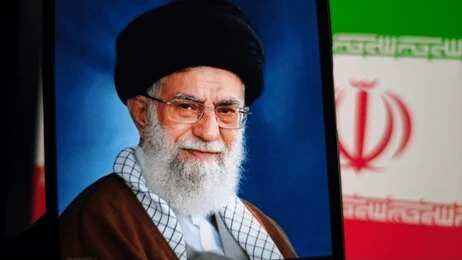
At the funeral of Iran’s Supreme Leader Ayatollah Ali Khamenei, a performer on stage asked a crowd of millions why President Trump was still alive — and the crowd roared back.
Story Snapshot
- Poet Mohammad Rasouli served as master of ceremonies at Khamenei’s funeral and openly called for Trump’s death over loudspeakers in front of millions of mourners.
- Mourners carried banners reading “Kill Trump” and threw stones at a portrait of the president during the procession in Tehran.
- Iranian officials say Khamenei was killed in a U.S. and Israeli airstrike, though no independent confirmation of that claim exists.
- At the same time, Iran and the U.S. are reportedly making progress in indirect peace talks — a sharp contrast to the rage on display at the funeral.
Open Death Threats From the Stage
Poet Mohammad Rasouli, serving as the event’s master of ceremonies, spoke into a microphone in front of millions of mourners in Tehran on July 5, 2026. He asked, “Why is the biggest bastard in the world still alive?” — a direct reference to President Trump. The crowd responded with chants of “Death to America” and “Death to Israel.” One mourner, Gholamreza Sabooni, told the Associated Press: “They killed our imam; we should kill their leader, Trump.”
Mourners also carried banners with the words “Kill Trump” and “Kill Bibi” — a reference to Israeli Prime Minister Benjamin Netanyahu. Video from the procession showed Iranians throwing stones at a portrait of Trump, a ritual borrowed from the Hajj pilgrimage that symbolizes the rejection of evil. U.S. federal agencies have tracked Iranian threats against Trump for years, dating back to the 2020 killing of Iranian General Qassem Soleimani.
What Iran Says Caused the Funeral
Iranian officials and state media say Khamenei was killed during U.S. and Israeli airstrikes in the opening phase of a military conflict. A small coffin belonging to his granddaughter, Zahra Mohammadi Golpayegani, was displayed alongside his casket — mourners cited her death as personal proof of the cost of the conflict. Iranian Foreign Minister Abbas Araqchi warned of an “immediate and powerful response” to any threats during the funeral, after Israeli Defense Minister Israel Katz hinted at a possible assassination plot.
Iranian officials claimed between 4 million and 15 million people attended the funeral, calling it potentially the largest in modern history. Delegations from roughly 100 countries attended, including representatives from China, India, and Russia. Khamenei’s son and newly named Supreme Leader, Mojtaba Khamenei, did not appear publicly at the procession. Officials cited security concerns, though his absence drew speculation.
The Contradiction Nobody in Tehran Wants to Talk About
While millions chanted for revenge and death, Iran and the United States were reportedly making quiet progress in indirect peace talks. Reports indicate negotiations mediated by Qatar and Pakistan have shown “positive progress” on issues including frozen Iranian assets and navigation rights. That gap — between the rage on display in the streets and the diplomacy happening behind closed doors — tells you something important about how governments use public grief as a political tool.
Watch: Khamenei Funeral Becomes Platform for Anti-Trump Hate, Death Threats https://t.co/PjGPcrFwTG
— Standard Issue Cog (@NuLLnVoiD4prez) July 6, 2026
It’s also worth noting that “Death to America” has been a fixture at Iranian state funerals since the 1980s. Scholars and historians note the phrase — in Persian, “Marg bar Âmrikâ” — is often translated officially as “Down with America” and has long been framed as an expression of anger at U.S. policy rather than a literal wish. But calling for the death of a sitting U.S. president by name, from a stage, with banners, is a different category entirely. Whether it reflects state policy or raw public emotion, the message reached the world — and the world was watching.
Sources:
redstate.com, youtube.com, ndtv.com, newsweek.com, facebook.com, washingtonexaminer.com