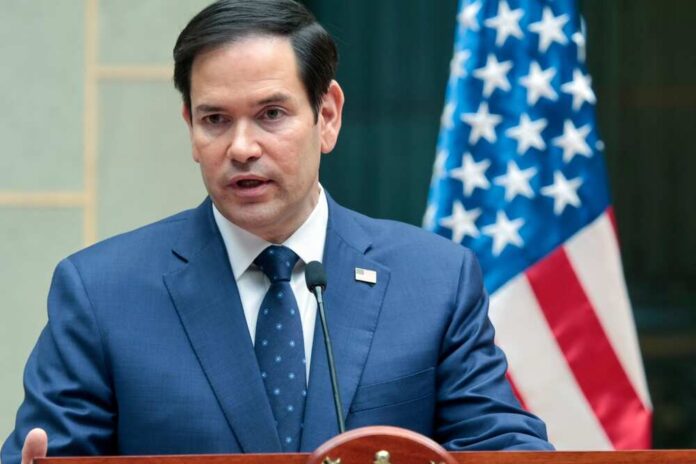
As Secretary of State Marco Rubio rallies more than 60 nations against far-left terrorism, he is betting that a tougher line on left-wing violence will fix a problem many Americans now blame on a distant and distracted federal government.
Story Snapshot
- Rubio is hosting a global summit in Washington on what he calls a “resurgence” of far-left political terrorism.
- The State Department has labeled four European far-left groups as foreign terrorist organizations since late 2025.
- Rubio says leaders have “excused” left-wing violence for years, while critics question the data and the politics behind this focus.
- The fight over how to define and rank political threats reflects deeper anger at a government seen as serving elites, not citizens.
Rubio’s Push to Put Far-Left Violence on the Global Agenda
Secretary of State Marco Rubio is bringing ministers from more than 60 countries to Washington for a meeting on “far-left political terrorism.” The Trump administration calls this a “resurgence” and says violent left-wing extremists, including anarchists and anti-fascists, are now a top terror threat alongside drug cartels and Islamist groups. The State Department says the gathering aims to expand coordination, improve information sharing, and strengthen law enforcement tools against far-left networks. For many Americans across the political spectrum, the striking part is not just the topic, but that Washington can move this fast on foreign terror labels while struggling to solve everyday problems at home.
Rubio argues that for too long, far-left violence has been a “blind spot” in global counterterrorism efforts. Internal concept papers and his public remarks say this threat has been underestimated and under-resourced even as attacks spread across borders. He points to firebombings, sabotage, and street beatings overseas as proof that far-left groups can kill and intimidate, just like other extremists. Supporters say this focus finally admits that violence is wrong no matter who does it, and that leaders cannot keep looking the other way when the attackers claim fashionable or “progressive” causes. Critics worry the summit is more about election messaging than cleaning up a broken security system.
New Terror Labels for Far-Left Groups, But Mixed Evidence on the Threat
Since November 2025, the State Department has formally designated four violent far-left organizations in Europe as foreign terrorist organizations. These include Antifa Ost in Germany and three groups in Italy and Greece linked to the broader anti-fascist movement. The designations make it a crime for Americans to provide money, training, or other support, and allow the government to freeze assets and bring terrorism charges. Rubio’s team also says the United States is offering rewards of up to $10 million for information about how these groups are financed, a sign they want to follow the money that backs political violence.
At the same time, major research on political violence paints a more complicated picture. A 2025 analysis for the Center for Strategic and International Studies found that left-wing attacks had risen from a very low baseline but still “remain much lower than historical levels of violence” by right-wing and jihadist extremists. Other reviews of decades of domestic terror data show that most deadly attacks in the United States still come from the right, not the left. This is where many Americans, right and left, feel the familiar pattern: officials highlight one threat that fits the current political story while the broader numbers show a system that has not really gotten safer or more fair.
Antifa, SPLC, and the Fight Over Who Counts as a Terrorist
Rubio and Trump have framed Antifa as part of a transnational terror network, even designating the movement as a “domestic terrorist organization” in administration strategy documents. Yet law enforcement and watchdog groups do not all agree on that label. The Federal Bureau of Investigation has described some Antifa-linked actors as “anarchist extremists,” but has not formally listed Antifa itself as a domestic terrorist organization. The Southern Poverty Law Center, which keeps a widely cited hate group map, says Antifa is not on its list and notes that it does not maintain a domestic terror list at all. That clash adds to public confusion over who decides when a political movement crosses the line from protest to terrorism.
Marco Rubio is throwing Democrats into a frenzy by dropping this truth nuke that terrorism is COMING FROM THE LEFT
"In all-out assault on our immigration officers, sniper attacks, explosives, armed ambushes, a transgender shooter opening fire on Catholic elementary school… pic.twitter.com/jWdpDbGN7d
— Trumpusa1 (@Trumpusa1A1) July 16, 2026
Even overseas, partners are split on Washington’s framing. Reporting on Rubio’s outreach says some allied governments “recoil” from the idea of a far-left terror crisis and have shown “less than enthusiastic” interest in making it a top priority. Commentators in mainstream outlets call the very category of “left-wing terrorism” hard to define and warn that vague labels can be turned against peaceful dissent. For readers who already see the “deep state” and other elites as self-protective, this mixed response looks familiar: powerful institutions argue over words and lists while families live with real violence, rising prices, and a sense that nobody in charge is honestly fixing the system.
Shared Frustration: Violence, Double Standards, and a Failing Government
Rubio’s core message at the summit is blunt: he says “the era of excusing left-wing violence has to end,” and that too many leaders have treated attacks as acceptable when they advance the “correct” politics. Many conservatives hear this and think of past riots, vandalism, and campus chaos they believe were brushed off as “mostly peaceful.” Many liberals hear the same line and remember hate crimes and militia violence they feel were downplayed because the attackers claimed patriotism or “America First.” Both sides, in their own way, see a justice system that applies rules unevenly depending on who is in power.
The larger story is not just about Antifa or four named groups in Europe. It is about whether the federal government can apply one clear standard to violence and extremism without bending it for donors, activists, or party allies. Rubio’s summit, the new terror labels, and the research pushback all show how hard that is in practice. When Washington treats political categories like weapons, ordinary citizens pay the price. They see leaders fly to conferences and issue long memos while neighborhoods struggle with crime, mental health, and economic strain that never get the same urgent attention. That growing anger, on the right and the left, is the real warning under this week’s headlines.
Sources:
abcnews.com, reuters.com, ndtv.com, facebook.com, thedailybeast.com, washingtonpost.com, youtube.com, dailysignal.com, washingtonexaminer.com, freebeacon.com, npr.org, lowyinstitute.org, justsecurity.org, pbs.org, en.wikipedia.org, pmc.ncbi.nlm.nih.gov