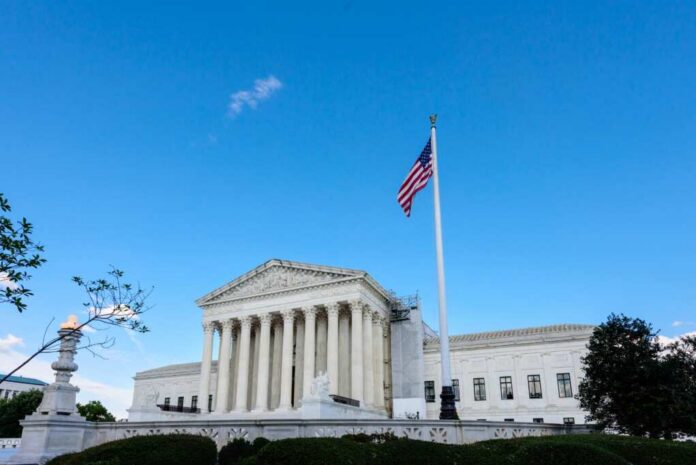
Supreme Court Justice Sonia Sotomayor unleashed a scathing 20-page dissent accusing her conservative colleagues of enabling unconstitutional racial profiling by ICE agents, exposing deep fissures within the nation’s highest court over immigration enforcement and civil liberties.
Story Snapshot
- Sotomayor’s dissent accuses conservative justices of approving violent ICE raids that target Latinos based on appearance and accent
- Supreme Court’s unsigned emergency order overturned lower court restrictions, allowing aggressive enforcement tactics to resume in Los Angeles
- Justice Kavanaugh’s concurrence defended ethnicity as a “relevant factor” in immigration stops, drawing sharp rebuke from liberal justices
- The ruling highlights the Court’s reliance on the opaque “shadow docket” for major policy decisions without full explanation
Conservative Majority Overrides Local Court Protections
The Supreme Court’s conservative majority issued an unsigned emergency order reversing a California district court’s restrictions on Immigration and Customs Enforcement operations. The lower court had imposed limits on ICE after reports surfaced of aggressive tactics targeting Latino workers in Los Angeles. Without oral arguments or detailed explanation, the Court’s 6-3 majority vacated the injunction, allowing federal agents to resume enforcement operations. This use of the emergency docket, often called the “shadow docket,” continues a pattern of rapid, unexplained rulings that bypass traditional judicial procedures. Critics argue this approach undermines transparency and accountability in consequential cases affecting millions of Americans.
Dissent Exposes Brutal Reality of Immigration Raids
Justice Sotomayor, joined by Justices Kagan and Jackson, described ICE operations as violent seizures involving firearms and physical force against individuals selected primarily for looking Latino, speaking with accents, or working low-wage jobs. She directly rejected Justice Kavanaugh’s characterization of raids as brief, polite inquiries, calling it a “fantasy” disconnected from documented reality. The dissent highlighted televised footage showing the coercive nature of these encounters, contrasting sharply with the majority’s abstract legal analysis. Sotomayor accused her colleagues of stripping constitutional protections from vulnerable communities and committing a “grave misuse” of the emergency docket to advance government power over individual rights. This unusually personal language signals alarm within the Court’s liberal wing about erosion of Fourth Amendment protections.
Kavanaugh’s Defense Sparks Ideological Clash
Justice Kavanaugh’s concurring opinion defended the government’s position, arguing that ethnicity could serve as one factor among others in immigration enforcement. He portrayed ICE encounters as routine law enforcement, minimizing reports of aggressive tactics that Sotomayor detailed in her dissent. This framing reflects a broader conservative view prioritizing executive branch flexibility in immigration policy over concerns about racial profiling. The stark disagreement between Kavanaugh’s benign description and Sotomayor’s account of violent raids illustrates how the Court’s ideological divide extends beyond legal interpretation to fundamental perceptions of reality. Conservative justices emphasize federal authority to enforce immigration laws, while liberal justices prioritize constitutional safeguards against discriminatory government action targeting specific ethnic communities.
Shadow Docket Precedent Threatens Judicial Oversight
The emergency ruling establishes precedent for immigration enforcement cases while weakening lower courts’ ability to check federal agencies. By providing no detailed explanation for overturning the district court’s carefully considered restrictions, the majority signaled that executive immigration priorities will receive deference on the Court’s emergency docket. This approach raises fundamental questions about judicial review and separation of powers. Short-term consequences include resumed ICE operations in sanctuary jurisdictions and heightened fear among Latino communities, regardless of citizenship status. Long-term implications threaten constitutional protections when government agents can rely on ethnicity as justification for stops and seizures. The decision reflects how unelected justices shape immigration policy through opaque procedures, frustrating Americans across the political spectrum who demand transparent, accountable government that respects both law enforcement needs and constitutional rights.
Barrett’s Crisis Denial Fuels Public Distrust
Justice Amy Coney Barrett’s recent public denial of any constitutional crisis at the Supreme Court drew criticism as tone-deaf given the internal conflicts exposed by Sotomayor’s dissent. Legal commentators characterized Barrett’s statement as disrespectful gaslighting that ignores her liberal colleagues’ documented concerns about the Court’s legitimacy and process. This disconnect between conservative justices’ public reassurances and the institutional turmoil evident in dissents feeds growing public skepticism about whether the Court serves ordinary citizens or powerful government interests. The situation reflects broader frustrations with federal institutions perceived as captured by elites indifferent to constitutional principles. Both conservatives concerned about unchecked government power and liberals worried about civil rights erosion find common ground questioning whether nine unelected judges wielding emergency authority without explanation serve justice or undermine the constitutional order they claim to uphold.
Sources:
SCOTUS Justice Sonia Sotomayor Shreds Colleagues in Blistering Dissent – The Daily Beast
U.S. Sotomayor on Conservative Colleague Gorsuch: He’s Such a Lovely Person – North Dakota Courts